
Looted Twice from Ukraine: PhD Student Traces an Object Stolen by the Nazis and Again by Russia
After attending the JDCRP’s online seminar “How to Research Nazi-Looted Art”—offered in partnership with the Central Institute for Art History, German Lost Art Foundation, and University of Cologne—PhD student Kateryna Kostiuchenko made a remarkable and disturbing discovery.
An object discussed in the seminar, looted during the Nazi era from Ukraine, had been stolen again—this time in 2022, by Russian forces plundering Ukraine’s Kherson Regional Museum.
The object—a lion sculpture from Olbia, built in the mid-4th century BCE—had been owned by Kherson since 1917. Recovered after World War II and processed at the Munich Central Collecting Point, it was restituted back to Kherson, where it remained for decades until this recent theft.
We asked Kostiuchenko how she traced the history of this Olbian lion, about provenance research in the Ukrainian context, and what this particular case suggests about cultural heritage in times of war.
As of this interview’s publication on June 1, 2026, Russian forces have destroyed or damaged over 2,500 cultural sites across Ukraine.
Tracing the Olbian Lion
JDCRP: You described recognizing the Olbian lion in a photograph shown during a JDCRP seminar on the Munich Collecting Point. What first struck your attention about the photograph, and how did you come to suspect it might correspond to a sculpture from the Kherson Regional Museum’s collection?
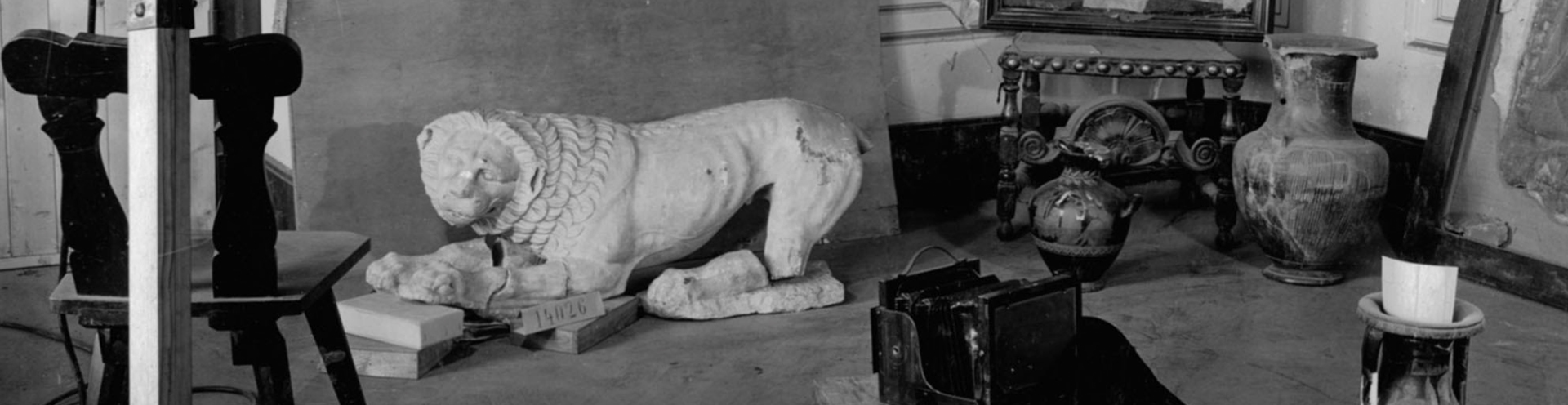
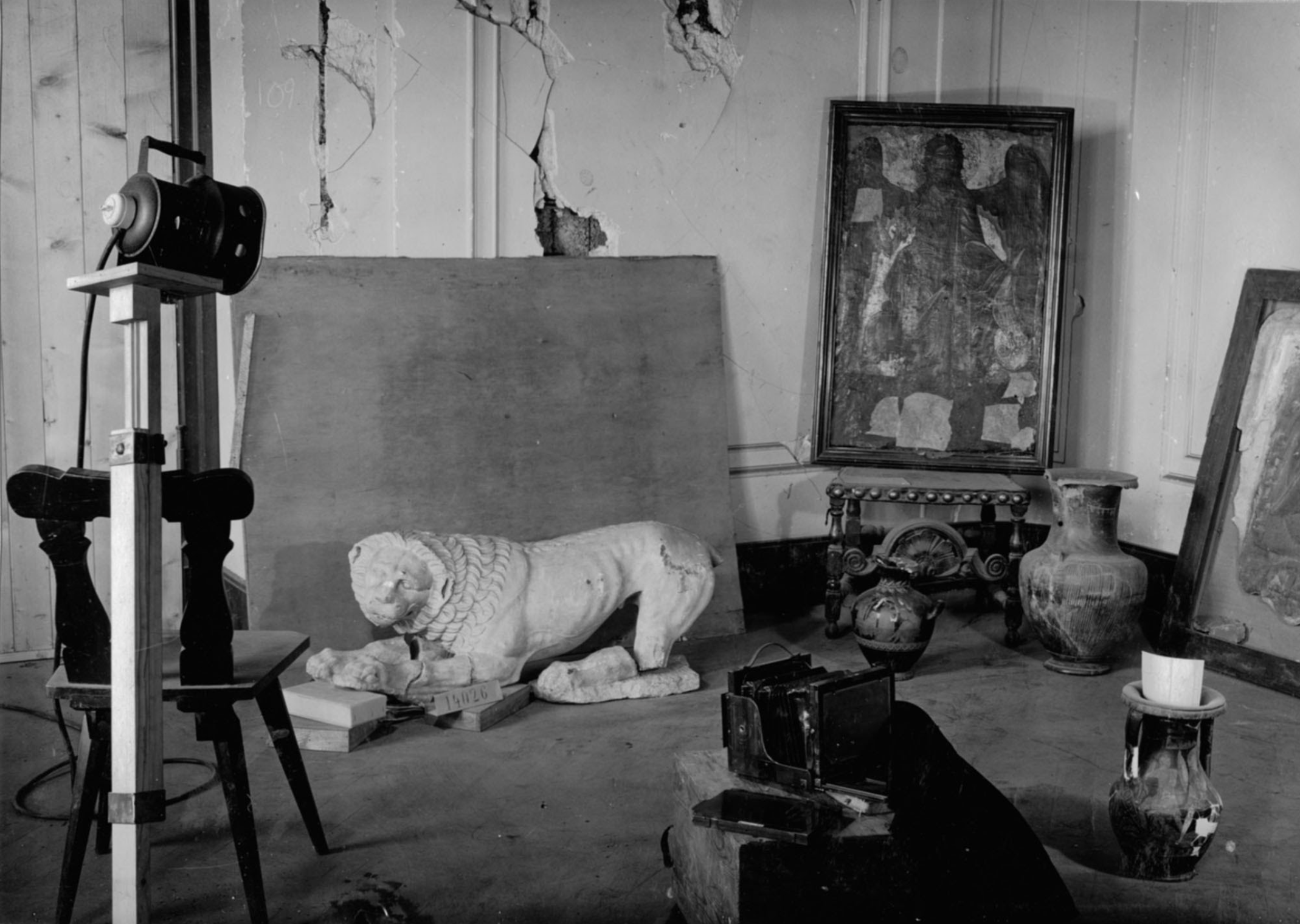
Kateryna Kostiuchenko: The photograph shown during the seminar was familiar to me from earlier academic work, but this time I had the opportunity to examine it more closely. While identifying the objects depicted, the distinctive form of a lion sculpture—especially the broken paws and the damaged tail—caught my attention.
A few days later, while consulting the Kherson Regional Museum’s scholarly catalogue for my dissertation, I unexpectedly encountered the same image again. This coincidence led me to consider whether both photographs might depict the same object, and it encouraged me to explore the connection with greater care.
JDCRP: After this initial recognition, how did you trace the sculpture’s journey? Which sources and archival records helped you? Did you consult any specific sources or use particular skills that were presented in the “How to Research Nazi-Looted Art” seminar?
Kateryna Kostiuchenko: To verify my initial impression, I returned to the image of the lion available through the Zentralinstitut für Kunstgeschichte and compared it directly with the photograph published in the Ukrainian catalogue. The match was unmistakable: both sculptures shared the same posture and identical distinctive damages. It was one of those moments familiar to provenance researchers—a mix of analytical satisfaction and a brief surge of excitement when a long‑sought connection suddenly becomes clear.
The Munich Collecting Point number was visible directly on the historical photograph, near the lion’s front paw. This allowed me to consult the database of Property Cards—hosted by the Deutsches Historisches Museum—which we had been introduced to during the JDCRP seminar “How to Research Nazi-Looted Art.” Under the entry CCP 14026, the card listed “Cherson” as the place of origin, confirming that the sculpture had been identified as from Ukraine and was shipped from Munich in 1947.
To understand the object’s later history, I contacted the Kherson Regional Museum. They confirmed that the lion had indeed been returned after the war but was stolen again during the Russian occupation of Kherson in 2022, together with other objects from the museum’s collection.
JDCRP: Do you know how and from where the Olbian lion first came to Kherson Regional Museum?
Kateryna Kostiuchenko: The sculpture entered the Kherson Museum in 1917 as part of a large antiquities collection assembled by the Moldavian collector and archaeologist Ivan Suruceanu. How exactly the lion entered Suruceanu’s collection remains unclear—but based on his known collecting practices, the lion may have come either from his own archaeological work at Olbia or through the active antiquities trade in the region.
After Suruceanu’s death in 1897, the Kherson Museum purchased a part of his collection. In 1917, more than 300 ancient objects, including the Olbian lion, were transferred there.
Provenance Research in the Ukrainan Context
JDCRP: What are some key challenges faced by provenance researchers seeking to trace movements of cultural objects from Ukrainian museums during the Nazi occupation?
Kateryna Kostiuchenko: As in many European museums, prewar collections in Ukraine were not fully inventoried, which complicates efforts to determine the scale of losses. The situation is further aggravated by the destruction of museum archives during the Second World War—particularly after 1941, when military operations took place largely on the territories of Ukraine and Belarus.
Another major difficulty concerns wartime evacuations. A portion of Ukrainian cultural objects was transported into the Russian Soviet Republic as well as to other eastern Soviet republics. Only part of these evacuated cultural assets were returned after the war. Moreover, postwar repatriation efforts often did not return objects to Ukraine; instead, many objects were transferred directly to Moscow.
Access to information about Ukrainian evacuated museum collections held in Russia remains closed to researchers. In contrast, archival materials preserved in Ukraine are publicly accessible, but they represent only the Ukrainian side of the documentation. Crucially, access to relevant Russian archives has long been restricted, including before the beginning of Russian aggression in 2014. These archival silences, combined with political and institutional barriers, hinder the reconstruction of collection histories.
JDCRP: What interests you personally about tracing objects relocated from Ukrainian museum collections during the Nazi occupation?
Kateryna Kostiuchenko: What interests me most about tracing objects relocated from Ukrainian museum collections during the Nazi occupation is the opportunity to better understand the historical context in which these decisions were made. I am particularly curious about the criteria behind selecting certain objects for removal and about the role of private collections, which remains a largely understudied area.
These questions resonate with my broader academic interests, and I hope to explore them more fully in future research—whether within my dissertation or in a separate project.
Cultural Heritage in Wartime
JDCRP: The Olbian lion was looted during World War II, then restituted back to Ukraine, and then stolen again by Russian forces plundering Kherson Regional Museum in 2022. What does this trajectory suggest to you regarding the importance—and vulnerability—of cultural heritage during war and invasion?
Kateryna Kostiuchenko: The trajectory of the Olbian lion is deeply painful for me as a Ukrainian researcher, yet it also illustrates, in a very concrete way, the extreme vulnerability of cultural heritage during war and occupation.
The systematic destruction and looting of Ukrainian cultural heritage today is not incidental; it is part of a deliberate strategy within Russia’s hybrid warfare. Ukrainians witness this daily, as cultural institutions are targeted, museum collections are plundered, and cultural infrastructure is intentionally erased in occupied territories. Investigations such as the Kyiv Independent’s “Curated Theft” and “Uncovering the secret Russian FSB operation to loot Ukraine’s museums,” as well as documentation compiled by Ukraine’s military intelligence service, demonstrate the scale and coordination of these actions.
One dimension of this strategy is rooted in a long-standing imperial policy aimed at marginalizing or erasing Ukrainian culture and replacing it with Russian narratives. The goal is clear: a population deprived of its cultural identity becomes more susceptible to assimilation. Ukrainians experienced this process of “Russification” for centuries—under the Russian Empire, later under the Soviet Union, and again in the years leading up to the events of 2014, when the country nearly lost its statehood. This is why many scholars and cultural professionals describe the current war as a colonial one.
Today, as we attempt to recover fragments of what has been lost, we increasingly turn to postcolonial studies to understand the mechanisms behind these processes. For Ukraine, the preservation of cultural heritage has become an existential matter. The study of our own history is now an urgent task for Ukrainian scholars and cultural professionals.
JDCRP: What do you think is the role of provenance research in preserving Ukrainian cultural heritage?
Kateryna Kostiuchenko: Provenance research plays an important role in preserving Ukrainian cultural heritage, especially now, when Ukraine is undergoing an intense process of rediscovering its own history and reclaiming cultural narratives. I am inspired by the dedication of Ukrainian scholars and by the openness of the younger, post‑Soviet generation. In the case of the Olbian lion, the Kherson museums—and the lion itself—became part of documenting Russia’s crimes against Ukrainian culture, illustrating how actively Ukrainian cultural professionals are responding to the challenges of the war.
In this context, adopting and adapting the best international practices—including, but not limited to, provenance research—is essential. For me personally, it is important to learn as much as possible about cultural objects displaced from Ukraine, regardless of the circumstances of their movement. Tracing these histories deepens our understanding of Ukrainian culture and restores knowledge that was obscured, helping Ukrainians reconnect with their cultural identity.
JDCRP: Is there anything else about this case or your research you would like to share?
Kateryna Kostiuchenko: If I may add one final thought, it is that Ukraine’s cultural sphere today is not separate from the broader struggle the country is facing. Cultural heritage has become one of the frontlines of this war, and the idea that “art is outside politics” is often used to obscure the political aims behind cultural destruction or cultural influence. For Ukraine, safeguarding our heritage, supporting our cultural institutions, and continuing research are essential parts of resisting aggression and ensuring that our cultural voice remains visible and heard. I am grateful that international colleagues and institutions are paying attention to this dimension of the war, and I hope this awareness will continue to grow.
Kateryna Kostiuchenko studied art and art history, with a focus on provenance research and collection history, in Kyiv, Augsburg, and Düsseldorf. Her research has included work on the documentary legacy of Franziskus Graf Wolff Metternich at the Vereinigte Adelsarchive im Rheinland, as well as provenance research on artworks from Museum Kunstpalast Düsseldorf that originated in the galleries of Julius and Max Stern.
After completing a research traineeship on the graphic works of Jankel Adler at the Von der Heydt-Museum in Wuppertal, she worked in artistic project management for the City of Wuppertal. From 2024 to 2025, she served as administrative and academic project manager for the “Deutsches Fotoinstitut” initiative at the Ministry of Culture and Science of North Rhine-Westphalia.
Her research interests include the displacement of Ukrainian museum collections during the Nazi occupation, as well as the so-called “trophy collections” transferred from German museums to Ukraine after the Second World War.